

Updated on: 02.02.26
Unlawful Searches in Drug Matters: The Most Common Mistakes That Affect Evidence (NSW)
If you’ve been charged with a drug offence in Sydney, the case often turns on one question: how did police get the evidence? In NSW drug matters, searches happen on the street, in cars, and during warrant raids. When police don’t have the legal power to search (or don’t follow the rules on how a search must be done), that can affect whether the evidence can be used in court.
Disclaimer: This article is general information about NSW law. It isn’t legal advice.
Why “unlawful search” matters in a drug case
NSW courts can exclude evidence that was obtained improperly or in contravention of an Australian law under s.138 of the Evidence Act 1995 (NSW). But it’s not automatic: the court weighs whether admitting the evidence is more desirable than excluding it, given the way it was obtained.
That’s why search-law issues are so important in drug cases: a problem with the search can become a problem with the prosecution’s evidence.
The main NSW laws police rely on in drug searches
Most drug-search disputes in NSW come back to:
- LEPRA (Law Enforcement (Powers and Responsibilities) Act 2002): sets out police powers to stop/search people and vehicles, strip-search rules, and search warrant procedures.
- Evidence Act 1995 (NSW): especially s 138, the discretion to exclude improperly/illegally obtained evidence.
The most common unlawful-search mistakes in NSW drug matters
1) No “reasonable grounds” for suspicion (street searches)
Police can stop, search and detain a person without a warrant if they suspect on reasonable grounds, including that the person has a prohibited drug/plant in contravention of the Drug Misuse and Trafficking Act 1985.
A common issue is when the suspicion is too vague, unsupported, or doesn’t connect to observable facts. If the lawful “trigger” for the power isn’t met, the search (and anything found) may be challenged.
2) No “reasonable grounds” for suspicion (vehicle searches)
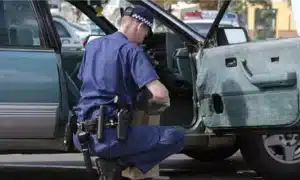
The same idea applies to vehicles: police can stop/search/detain a vehicle without a warrant where they suspect on reasonable grounds (including that it contains a prohibited drug/plant).
In practice, disputes often arise about why the car was stopped, what the officer relied on, and whether the grounds genuinely supported a drug search.
3) Using “consent” when consent wasn’t real or was unclear
Sometimes police ask to search and rely on a person “agreeing” (or not clearly objecting). Problems can arise if:
- it wasn’t clearly asked as a choice, or
- the person felt they couldn’t say no, or
- consent is later disputed.
Legal Aid NSW (a NSW government body) explains a practical approach: if police want to search you, you can say you do not consent, but if police proceed you should comply (don’t stop or hinder them). If the police didn’t have the power and you didn’t consent, that may support an argument to keep evidence out of court.
4) Escalating to a strip search without meeting the legal threshold
Strip searches have a higher legal bar.
Under LEPRA, police may carry out a strip search if they suspect on reasonable grounds it’s necessary for the search. If it’s done anywhere other than a police station or other place of detention, police must also suspect on reasonable grounds that the seriousness and urgency make the strip search necessary.
Common problems include:
- treating a strip search as routine, rather than “necessary”, or
- failing to justify seriousness/urgency when it’s done outside a station.
5) Not following privacy, dignity, and “least invasive” requirements
Even when police have a lawful basis to search, LEPRA requires safeguards.
Examples of requirements include:
- police must tell the person whether clothing must be removed and why it’s necessary, and ask for cooperation
- the search must be conducted with reasonable privacy, as quickly as reasonably practicable, and in the least invasive way practicable
- a search must generally be conducted by an officer of the same sex as the person searched
If these safeguards aren’t followed, it can support an argument that the evidence was obtained improperly (even if police had some power to search).
6) Strip searches conducted in a way LEPRA doesn’t allow
LEPRA sets detailed rules for strip searches. For example, as far as reasonably practicable:
- the strip search must be conducted in a private area
- it must not be conducted in view of a person of the opposite sex
- a child (10–17) or a person with impaired intellectual functioning has additional protections about who must be present
These issues can be critical in drug matters, because strip-search compliance is frequently contested.
7) Overstepping “mouth or hair” powers
LEPRA includes an ancillary power: if police are searching a person under s 21 and suspect on reasonable grounds the thing is concealed in the person’s mouth or hair, police may require the person to open their mouth or move their hair. But LEPRA does not authorise forcibly opening a person’s mouth.
Warrant raids: common execution mistakes that can affect evidence
Drug investigations often involve search warrants. LEPRA includes specific “occupier” protections and rules for executing warrants.
8) Not serving the occupier’s notice properly
LEPRA requires an occupier’s notice to be prepared and served, including rules about when it must be served for warrants other than covert warrants.
9) Failing to announce authority and give an opportunity to allow entry
Before entering, one executing person must:
- announce they are authorised by the warrant, and
- give anyone on the premises an opportunity to allow entry,
unless an exception applies (e.g., covert warrant or immediate entry is required for safety or to prevent frustration of execution).
10) Refusing to show the warrant when requested
If an occupier requests it, a person executing a non-covert warrant must produce the warrant for inspection.
11) Executing a warrant “by night” without authorisation
A warrant (other than a covert search warrant) may be executed by day, but must not be executed by night unless the issuing officer authorises night execution. LEPRA defines “by day” (6am–9pm) and “by night” (9pm–6am).
12) Use of force beyond what’s “reasonably necessary”
LEPRA allows force to enter premises pursuant to a warrant, but only such force as is reasonably necessary for entry.
How an unlawful search becomes an “evidence challenge” (s.138 Evidence Act)
Section 138 says evidence obtained improperly/illegally is not to be admitted unless the desirability of admitting it outweighs the undesirability of admitting evidence obtained that way. The court must consider factors (set out in the section), such as the importance of the evidence, the nature of the offence, and the gravity of the impropriety/contravention.
In plain terms:
- Proving a breach (no power / wrong process) is step one.
- Persuading the court to exclude is step two — and it depends on the balancing exercise in s.138.
If you think a drug search was unlawful: practical steps (without making things worse)
Legal Aid NSW’s guidance is a helpful baseline:
- If police want to search you, you can say you do not consent.
- If police proceed anyway, you should comply and not hinder police.
Afterwards, it can be important to record details while they’re fresh (time, location, what was said, whether a strip search occurred, who was present), and get legal advice early—because challenges often depend on precise facts and documents (e.g., body-worn video, warrant paperwork).
Speak with a Sydney drug lawyer early
If you’re facing drug charges in Sydney and the case involves a police search (street, vehicle, or warrant raid), early legal advice can make a real difference—especially where there may be issues with the power to search or how it was carried out.
Contact Ly Lawyers today for immediate, experienced representation in all drug matters.